
ATS for Staffing Agencies: How to Choose the Right System
Introduction
Staffing agencies deal with a recruitment process that is more complex than simply collecting applications for one company. A recruiter may be working on several client requirements at the same time, while the same candidate might be suitable for more than one role.
Client feedback can arrive through email, phone calls or messages, while interview details may sit in different calendars. As the number of jobs and candidates increases, keeping everything organised becomes difficult.
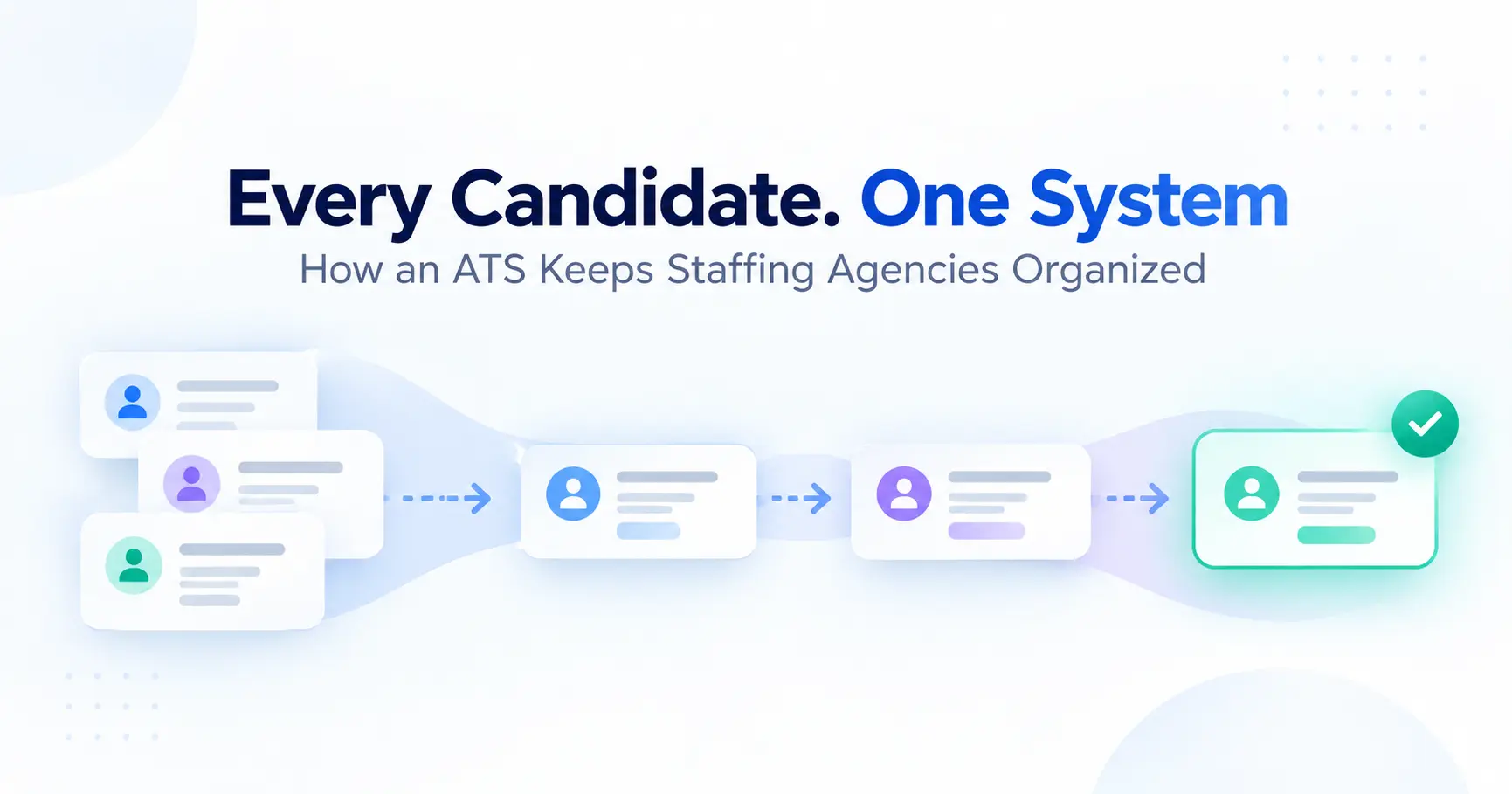
That is where an ATS for staffing agencies can make a practical difference. An applicant tracking system helps staffing firms manage candidate records, job requirements, communication, interviews, submissions and placements from one central platform.
More importantly, an agency-focused ATS is designed to support multiple clients rather than a single employer. The right system does not replace recruiters. It gives them a clearer way to manage information, reduce repetitive work and find relevant candidates more efficiently.
What Is an ATS for Staffing Agencies?
An ATS for staffing agencies is recruitment software used to manage candidates and hiring workflows across multiple client companies. It stores information such as candidate profiles, resumes, skills, job applications, recruiter notes, interview stages, communication history and placement activity.
For staffing firms, the relationship between three things is especially important:
A recruiter should be able to see which candidate has been considered for which vacancy, which client owns that requirement and what happened at each stage of the recruitment process.
This is different from a traditional corporate ATS. A corporate recruitment team usually hires for one organisation, while a staffing agency may be filling positions for dozens of businesses at the same time.
Staffing Agency ATS vs. Traditional ATS
| Traditional ATS | Staffing Agency ATS |
|---|---|
| Primarily built for one employer | Designed for multiple clients |
| Tracks candidates for internal vacancies | Tracks candidates across client jobs |
| Focuses on internal hiring managers | Supports recruiters and external clients |
| CRM features may be limited | Client management is often important |
| Candidate history may stay job-specific | Candidates can be reused for future roles |
| Mainly tracks applications | Often tracks submissions and placements |
This difference matters because software that works well for an internal HR team may not fit the daily workflow of a staffing business.
Why Staffing Agencies Need an ATS
Many agencies begin with spreadsheets, inboxes, job portals and shared documents. That approach can work while the candidate database is small. The problems usually appear as the agency grows.
Candidate details may be stored in different places. Recruiters may create duplicate records. Important notes can remain in personal inboxes. A candidate who was interviewed several months ago may be forgotten even though they are a strong fit for a new vacancy.
An ATS creates a common place for this information. One of its useful capabilities is candidate rediscovery.
For example, if a client requests a finance manager with specific industry experience, a recruiter with a structured candidate database can first search people already sourced during previous assignments instead of immediately starting the sourcing process again.
A candidate who was not selected for one job may still be suitable for another role. A searchable database helps recruiters make previous sourcing work useful again.
An ATS can also help reduce:
- Duplicate candidate records
- Missed follow-ups
- Repeated manual data entry
- Unclear candidate status
- Lost client feedback
- Duplicate submissions
- Scattered recruiter notes
- Manual reporting
- Dependence on individual spreadsheets
The result is not simply a cleaner database. It gives recruiters better visibility into what is happening across jobs, candidates and clients.
How an ATS Works in a Staffing Agency
The easiest way to understand an agency ATS is to follow a typical recruitment workflow from the initial client requirement through candidate placement.
1. The Client Requirement Is Added
The process usually starts when a client shares a vacancy. The recruiter records important information such as the job title, required skills, experience, location, employment type, client contact, compensation details where applicable, vacancy status and assigned recruiter.
This creates the job record that the rest of the recruitment activity can connect to.
2. Candidates Enter the Database
Candidates can come from multiple sources, including job applications, referrals, recruiter sourcing, existing databases, career pages and supported job-board can make a practical difference. An integrations.
Instead of treating each resume as an isolated file, the ATS creates a structured candidate record containing information such as experience, contact details, skills, resumes, recruiter notes, communication history and previous applications.
3. Recruiters Search and Shortlist
Recruiters can search the candidate database using criteria such as skills, experience, location, job title, availability or keywords from resumes.
This is one of the most important capabilities for a staffing agency. A database containing thousands of candidates is only useful if recruiters can find relevant people quickly.
4. Candidates Move Through the Pipeline
Candidates can be moved through defined stages such as:
The exact workflow depends on the agency. A permanent recruitment company may have a different process from a temporary or contract staffing business. Good recruitment software should allow the workflow to reflect how the team actually works.
5. Communication Is Recorded
Recruitment involves constant communication with both candidates and clients. An ATS can help maintain records of emails, notes, interview details, follow-up tasks and feedback.
This becomes particularly useful when several recruiters work on the same client account. Instead of asking another recruiter what happened, the team can check the relevant candidate or client record.
6. Placement Activity Is Tracked
Once candidates move through interviews, offers and placement, managers can review recruitment activity. Depending on the platform, reports may cover submissions, interviews, placements, candidate sources, recruiter activity and time taken to fill vacancies.
Essential ATS Features for Staffing Agencies
Not every staffing firm needs the longest possible feature list. The better question is which features support the recruiter's actual workflow.
Searchable Candidate Database
A strong candidate database is the foundation of an agency ATS. Recruiters should be able to search previous candidates instead of repeatedly sourcing from zero.
Search may include skills, job titles, experience, location, resume keywords and other relevant filters. This allows older candidate records to remain useful rather than becoming an archive nobody opens.
Resume Parsing
Resume parsing extracts information from candidate resumes and turns it into structured fields. This can reduce repetitive manual entry.
For example, the software may identify a candidate's name, contact details, work history, education and skills automatically. Parsing can save time, although recruiters should still check important information because resume formats can vary.
Multi-Client Job Management
A staffing agency needs to manage vacancies from several organisations without creating confusion.
Recruiters should quickly be able to answer which jobs are open, which client owns each requirement, who is managing it, which candidates have been submitted, which candidates are interviewing and what feedback has been received.
Recruitment CRM
Staffing agencies work with relationships as much as applications. A recruitment CRM can help teams manage client companies, contacts, conversations, follow-ups and business activity.
For many agencies, having ATS and CRM functions connected is more practical than keeping candidate activity and client information in unrelated systems.
Candidate Submission Tracking
Submitting candidate profiles to clients is a central part of agency recruitment. The ATS should allow recruiters to record the candidate, client, job, date of submission, current status and client feedback.
Good submission tracking also helps reduce the risk of sending the same candidate to a client twice.
Workflow Automation
Automation can reduce repetitive administrative work. For example, an ATS may support automated reminders, task creation, notifications or stage-based actions.
Automation should be used carefully. If the recruitment process itself is unclear, automating it will not solve the underlying problem. Agencies should first decide how work should move through the system and then automate repetitive steps that genuinely save time.
Reporting and Analytics
Recruitment managers need visibility into more than the number of candidates in the database.
Useful reports may include open jobs, candidates sourced, candidate submissions, interviews, offers, placements, source performance, recruiter activity, pipeline conversion and time to fill.
The most useful reports are the ones that answer real operational questions. A dashboard full of numbers has little value if managers cannot use those numbers to understand where recruitment is slowing down.
Different Staffing Models Need Different ATS Capabilities
Not every staffing agency operates in the same way. That means the right ATS depends partly on the type of recruitment being managed.
Permanent Recruitment Agencies
Permanent recruitment firms typically need strong candidate search, client management, submission tracking, interview management and placement records.
Candidate rediscovery is especially useful because people considered for one permanent role may fit another position later.
Temporary Staffing Agencies
Temporary staffing can require additional functionality. Depending on the agency, this may include worker availability, assignments, shifts, timesheets, documentation or integration with payroll and billing systems.
Contract Staffing Agencies
Contract recruitment may require visibility into start dates, contract periods, renewals, assignment status and rates.
Agencies should check whether these capabilities are built into the platform or require additional software.
High-Volume Recruitment Teams
High-volume staffing teams usually care strongly about speed and repeatability. Bulk actions, quick screening, database search, communication tools and automation may become particularly important.
The key is choosing functionality that supports the staffing model rather than paying for complexity that the business will rarely use.
Benefits of Using an ATS for Staffing Agencies
A well-implemented ATS can improve several parts of the recruitment operation.
Better Use of Existing Candidates
Recruiters can search previous candidate records before starting another sourcing exercise. This helps agencies get more value from work they have already done.
Improved Team Collaboration
Recruiters work from shared candidate and client information rather than relying entirely on personal spreadsheets or inboxes. This is useful when roles are reassigned or multiple team members work on the same account.
More Consistent Follow-Ups
Tasks, reminders, communication history and recruitment stages make it easier to see what needs to happen next. Candidates are less likely to disappear from the process simply because somebody forgot a follow-up.
Less Repetitive Administration
Resume parsing, templates, scheduling, integrations and sensible automation can reduce manual work. Recruiters can then spend more time speaking with candidates and clients.
Better Client Visibility
Connecting clients with jobs, submissions, interviews and feedback gives recruiters more context. Someone taking over an account can understand its recent recruitment activity without rebuilding the history manually.
Clearer Recruitment Reporting
Managers can see where the recruitment pipeline is slowing down. For example, a large number of submissions with very few interviews may indicate a different problem from a pipeline where many candidates interview but few offers are made.
How to Choose the Right ATS for Your Staffing Agency
Choosing an ATS should begin with the recruitment process, not the software demonstration.
Map Your Current Workflow
Write down what happens from the moment a client shares a requirement until a candidate is placed.
Ask practical questions. Where do recruiters store resumes? How are screening notes recorded? How are profiles sent to clients? Where does interview feedback go? How are follow-ups managed?
These answers reveal the problems the software actually needs to solve.
Separate Must-Have Features From Nice-to-Haves
Create a simple list of essential features, useful features and features you probably will not use.
This prevents impressive but unnecessary functionality from distracting you from everyday requirements.
Test Candidate Search Properly
Candidate search should be tested with realistic examples. Ask how recruiters would find people from a large historical database using the same criteria they use in normal recruitment.
If finding older candidates is difficult, the value of the database decreases quickly.
Test the Full Recruitment Workflow
Do not judge the platform from the dashboard alone. Check how many steps common tasks require and whether information appears where recruiters expect it.
Review Integrations
Check the tools your agency already uses. This may include job boards, email, calendars, communication tools, payroll systems, billing software and other recruitment applications.
Do not assume every ATS supports every integration. Confirm the workflows that your team actually needs.
Consider Recruiter Adoption
Software only delivers value if the team actually uses it. Recruiters should test common tasks such as adding candidates, searching records, updating stages, recording notes and managing submissions.
A system can have excellent functionality and still fail if everyday tasks feel unnecessarily difficult.
Understand the Real Cost
Look beyond the advertised subscription. Depending on the vendor, costs may include additional users, implementation, data migration, training, add-on modules, integrations, support and contract commitments.
Comparing the full cost gives a more realistic picture of what adopting an ATS will involve.
Review Data Security and Access
Staffing agencies handle a large amount of candidate and client information. Review user permissions, data ownership, export options, security practices, privacy controls and any requirements that apply to your business.
Common Mistakes When Selecting an ATS
One common mistake is buying a corporate ATS without checking how it manages multiple clients. Another is choosing software because it has the longest feature list. More features can also create more configuration, training and complexity.
Agencies also sometimes overlook candidate search. A polished interface does not help much if recruiters cannot quickly rediscover people already stored in the database.
Data migration is another area that deserves attention. Moving years of duplicate and inconsistent records into a new ATS does not automatically make the data cleaner.
Finally, avoid automating everything. Recruitment still depends heavily on conversations, judgement and relationship-building. Automation should support those activities rather than make candidate communication feel mechanical.
Frequently Asked Questions
What is the best ATS for staffing agencies?
There is no single best option for every agency. The right ATS depends on the recruitment model, team size, candidate volume, client workflow, required integrations, reporting needs and budget.
Do small staffing agencies need an ATS?
Small agencies may not need complex software immediately. An ATS becomes useful when candidates, jobs, client communication and follow-ups become difficult to manage consistently using spreadsheets and inboxes.
Is an ATS the same as recruitment software?
An ATS is a type of recruitment software focused mainly on candidates, jobs and hiring stages. Broader recruitment platforms may also include CRM, onboarding, workforce management, automation, analytics, timesheets or billing functionality.
What is the difference between an ATS and recruitment CRM?
An ATS focuses primarily on managing candidates through recruitment stages, while a recruitment CRM focuses more on relationships and communication with candidates and clients. Staffing agencies often benefit from having both capabilities connected.
Can an ATS manage candidates for multiple clients?
Agency-focused ATS platforms are generally designed to support multiple client vacancies. The exact workflow varies, so agencies should test how candidates, submissions and client jobs are connected before choosing a platform.
What features should staffing agencies look for in an ATS?
Important features usually include a searchable candidate database, multi-client job management, candidate submission tracking, recruitment CRM, communication tools, workflow management, integrations, reporting, permissions and recruiter-friendly usability.
Conclusion
The right ATS can help staffing agencies keep candidates, client jobs, communication and recruitment stages organised in one place. Rather than choosing software based on the longest feature list, focus on how well it supports your recruiters' actual workflow, candidate search, client management, reporting and day-to-day usability.
If you are looking for a more organised way to manage recruitment activities, you can explore RecruitPro Enterprise and see how its recruitment solution fits your staffing agency's needs.